Guides / The diner and the airplane
The diner and the airplane: how Tray Rush's two venues play
Tray Rush has two places to work. They share the same scoring, timers and penalties, but the rooms, the guests and the busy spells are different, and each one rewards a different habit. The distances here are measured from the floor plans in the game's code.
What stays the same
Both venues use one set of rules: the same coins per serve, the same tips and combos, the same patience bar for each level and the same cost for a miss. You walk at 4.2 metres per second in both, you can carry two dishes, and the kitchen counter in the diner and the galley on the plane each have five places for finished dishes. What changes is how far you walk, how you hand a dish over, who orders and what interrupts you.
The diner floor
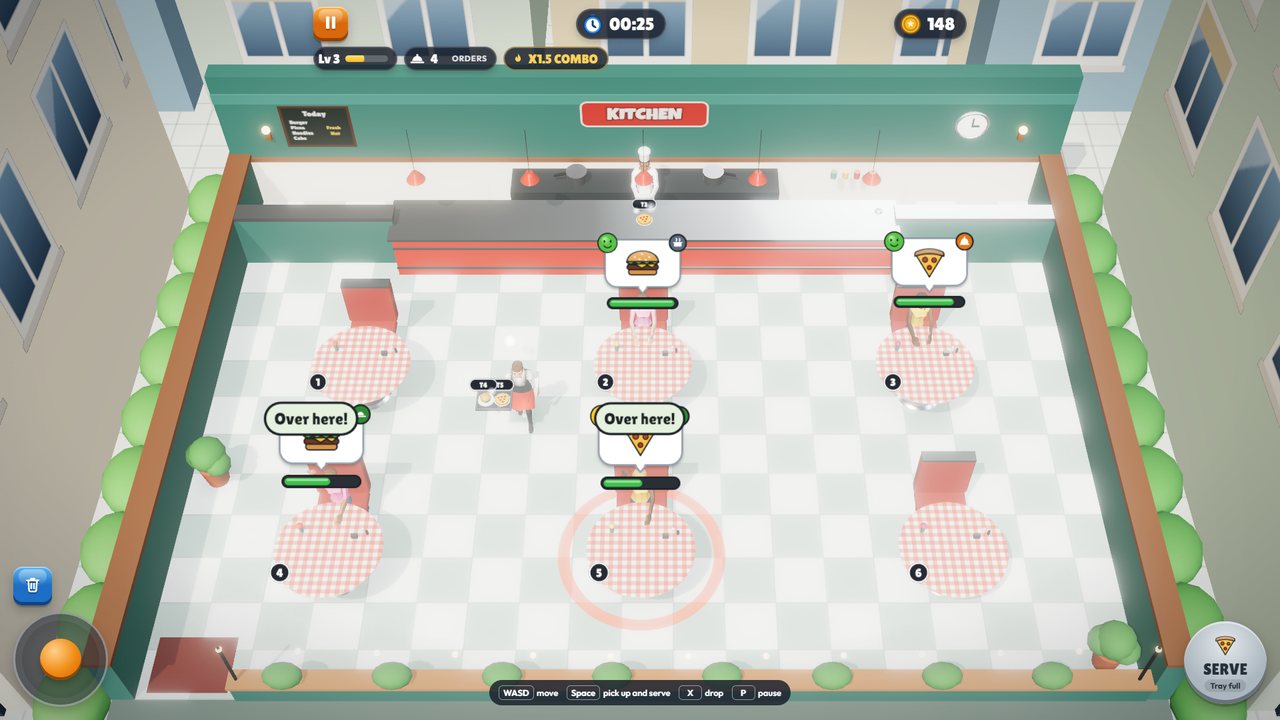
The diner has six tables and a kitchen counter along the back wall. The floor turns to fit your screen. On a phone held upright it is 9.4 metres wide and 13.6 metres deep, with the tables in three rows of two. On a wide screen it is 15 metres wide and 10.4 deep, with two rows of three.
On a tall phone, the far tables are about 9 metres from the counter, a little over two seconds of walking each way. That is the main cost in the diner: every trip to the back row is four seconds there and back. When two dishes are ready, the pair worth carrying together is the pair in the same row.
You don't need to reach a chair to serve. Any spot within 1.9 metres of a table's centre counts, so you can hand a plate over from whichever side you reach first, and you can pick a dish up from 1.4 metres away from its place on the counter.
Diner guests
Three guests are already seated when a shift starts. Everyone else walks in through the entrance at 1.6 metres per second and takes a moment to sit before ordering. After eating, a happy guest stands up and leaves, and the table is free for the next one. An angry guest storms out more than twice as fast.
When you carry a guest's dish and come within 1.3 to 3.6 metres of them, they wave at you. On a full floor that wave is the quickest way to spot whose plate you are holding.
The airplane cabin
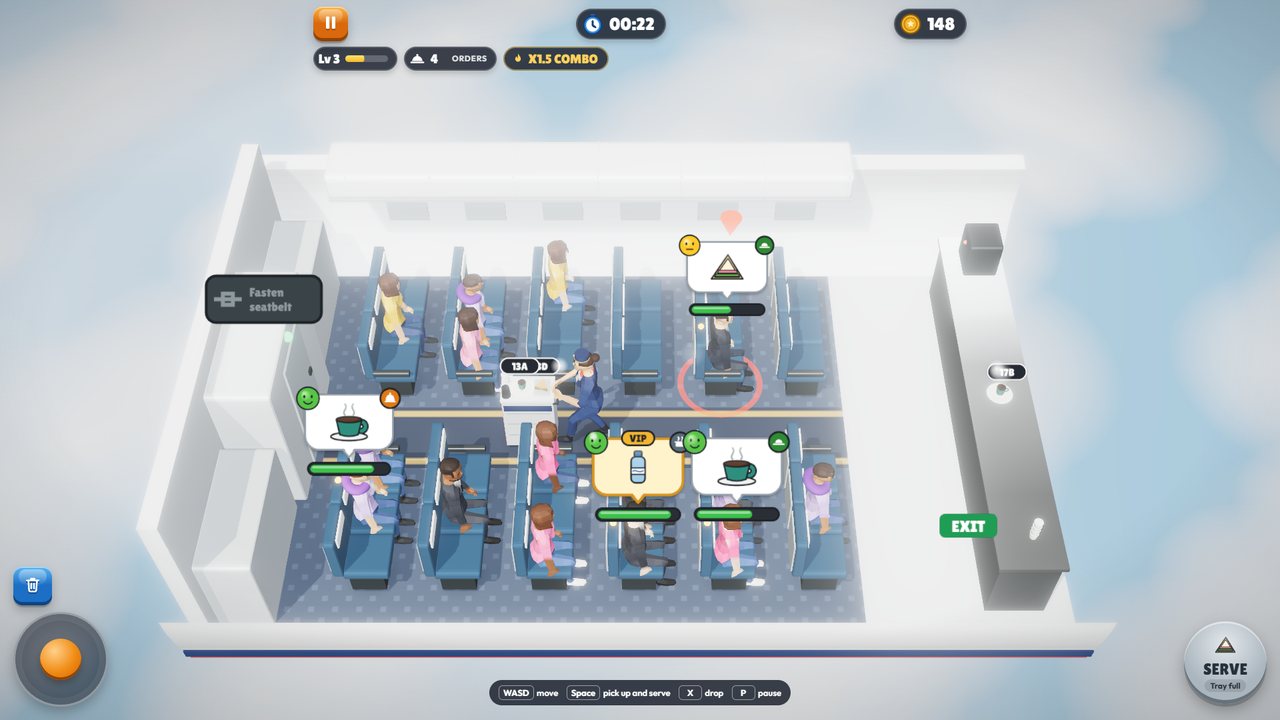
The cabin has 36 seats in six rows, numbered 12 to 17, with seats A to C on one side of the aisle and D to F on the other. The aisle is 84 centimetres wide, the rows are a metre apart, and the galley is at the front. On a wide screen the whole cabin turns sideways so it runs across the screen.
The cabin is smaller than it looks. From the galley to the back row is about 6.3 metres, an easy second and a half, and the front row is barely more than a metre away. You never leave the aisle to serve: standing in the aisle within 0.8 metres of a row's centre is enough to serve a window seat. On the plane the trolley holds your two dishes, so the crew push it out with the meals and pull it back to the galley.
Passengers
Every seat has an even chance of a passenger when the shift starts, so about half the cabin is full, and one passenger in five is a VIP guest. Passengers never leave the plane. After eating, a passenger waits 8 to 14 seconds before they may order again, so the same people keep ordering for the whole shift.
An angry passenger gets up and storms off to the lavatory at the back, stays for 6 seconds, comes back and then waits 10 to 16 seconds before ordering again. So a miss on the plane does not empty the seat for long.
That changes how I play the plane. Someone I have just served won't order for at least 8 seconds, so I can take my eyes off that row and watch the others.
The menus
Level 1 has three dishes, and every level adds one until the full menu of eight is open at level 6. The kitchen cooks whatever is ordered, so the menu doesn't change the work, but more dishes means more bubbles that look alike.
| Level | Diner | Airplane |
|---|---|---|
| 1 | Burger, coffee, pizza | Coffee, juice, sandwich |
| 2 | adds noodles | adds tea |
| 3 | adds salad | adds water |
| 4 | adds fries | adds the meal tray |
| 5 | adds sushi | adds the snack pack |
| 6 and up | adds cake | adds cup noodles |
Dinner rush and turbulence
Each venue has its own event, and both start at the same point: the moment you have served half of the level's orders.
- Dinner rush. For 20 seconds new orders arrive twice as fast. The limit on open orders still holds, so the rush fills every table you have room for and then waits for you.
- Turbulence. For 8 seconds the seatbelt sign is on and you walk at 70% of your speed, about 2.9 metres per second. The galley to the back row goes from 1.5 seconds to about 2.1.
The rush is the harder of the two, because it lasts longer and adds work rather than slowing it down. Turbulence is short, and the cabin is small enough that a slower walk costs well under a second a trip.
Which one to play first
I suggest the diner for your first shifts. Guests come and go, the tables are easy to tell apart, and the long walks teach you to carry two plates at once. The plane is quicker on foot but busier to read: 36 seats, regulars who order again and again, and VIP guests seated from the start. Your levels and stars are saved for each venue separately, so you can switch whenever you like.
Keep reading
For coins, combos, VIP orders and stars, see the numbers behind a three-star shift. The Tray Rush guide covers the controls and every level, and How Tray Rush was made explains how both rooms were built.
I write these guides with help from Claude, an AI assistant, and check every number against the game's code before a guide goes up.