Guides / Tray Rush scoring
Tray Rush strategy: the numbers behind a three-star shift
I tuned every number in Tray Rush, so here is how they fit together: what a serve is really worth, what a miss really costs, and how busy each level gets. Every figure on this page comes from the game's rules file.
What one serve is worth
Each serve pays 10 coins plus a speed tip. The tip is the share of the customer's patience bar that is still left when the plate lands, counted in tenths and rounded up, and it is never less than 1. Serve with 64% of the bar left and the tip is 7. Serve with a sliver left and it is 1. So the gap between a quick serve and a slow one is 9 coins.
The combo then multiplies that. Your third serve in a row pays one and a half times as much, and your sixth in a row pays double, until a miss sends the count back to zero. A VIP order doubles whatever the serve is worth after the combo. Here is what that looks like for four different tips:
| Speed tip | No combo | x1.5 combo | x2 combo | VIP at x2 |
|---|---|---|---|---|
| 10 (more than 90% left) | 20 | 30 | 40 | 80 |
| 7 (61% to 70% left) | 17 | 26 | 34 | 68 |
| 4 (31% to 40% left) | 14 | 21 | 28 | 56 |
| 1 (10% or less left) | 11 | 17 | 22 | 44 |
Read the table across and then down. Speed adds at most 9 coins to a plain serve, while a running combo doubles everything. When I play, I protect the streak first and chase tips second.
What a miss really costs
A customer who runs out of patience costs 15 coins on level 1 and 3 more on every level after it: 27 on level 5 and 36 on level 8. That is the number you see. The cost you don't see is the combo, because a miss resets the streak. The next two serves pay the plain rate and the three after that pay one and a half times.
Here is a real example. You are on level 5 with a streak of six or more, serving with about 70% of the bar left, so each serve pays 34. One customer walks out. Your next five serves pay 17, 17, 26, 26 and 26, which is 112 coins instead of 170. Add the 27-coin penalty and that one miss has cost you 85 coins, more than three times the number on the screen.
That is why the right move is often to give up some tip to save the streak. When two orders are waiting, I serve the one closest to running out, even if the other one would pay a bigger tip.
The first few coins
Every shift starts with 20 coins, and you are fired the moment they reach zero. On level 1 a miss costs 15, so two misses before your first serve end the shift: 20, then 5, then minus 10. After that the coins build up quickly, and finishing a level adds a 10-coin bonus on top. The first serve of a shift is the one I never take a risk with.
How busy each level gets
Three numbers decide how hectic a level feels, and only one of them is on screen. The patience bar shrinks by 6 seconds a level, from 60 seconds on level 1 to 20 seconds from level 8. The other two are hidden: how many orders can be open at once, and how long the game waits before the next customer orders.
| Level | Orders open at once | Seconds between new orders | Patience |
|---|---|---|---|
| 1 | 2 | about 8 | 60 s |
| 2 | 3 | about 7.1 | 54 s |
| 3 | 4 | about 6.2 | 48 s |
| 4 | 5 | about 5.3 | 42 s |
| 5 | 6 | about 4.4 | 36 s |
| 6 | 6 | about 3.5 | 30 s |
| 7 | 6 | about 2.6 | 24 s |
| 8 and 9 | 6 | about 2.5 | 20 s |
The gap between orders varies by up to a fifth either way, so customers never order like clockwork, and people still walking to their seat count toward the limit. Level 5 is where the game changes character: six orders can be open, a new one arrives every 3.5 to 5.3 seconds, and the bar is down to 36 seconds.
The kitchen and your two hands
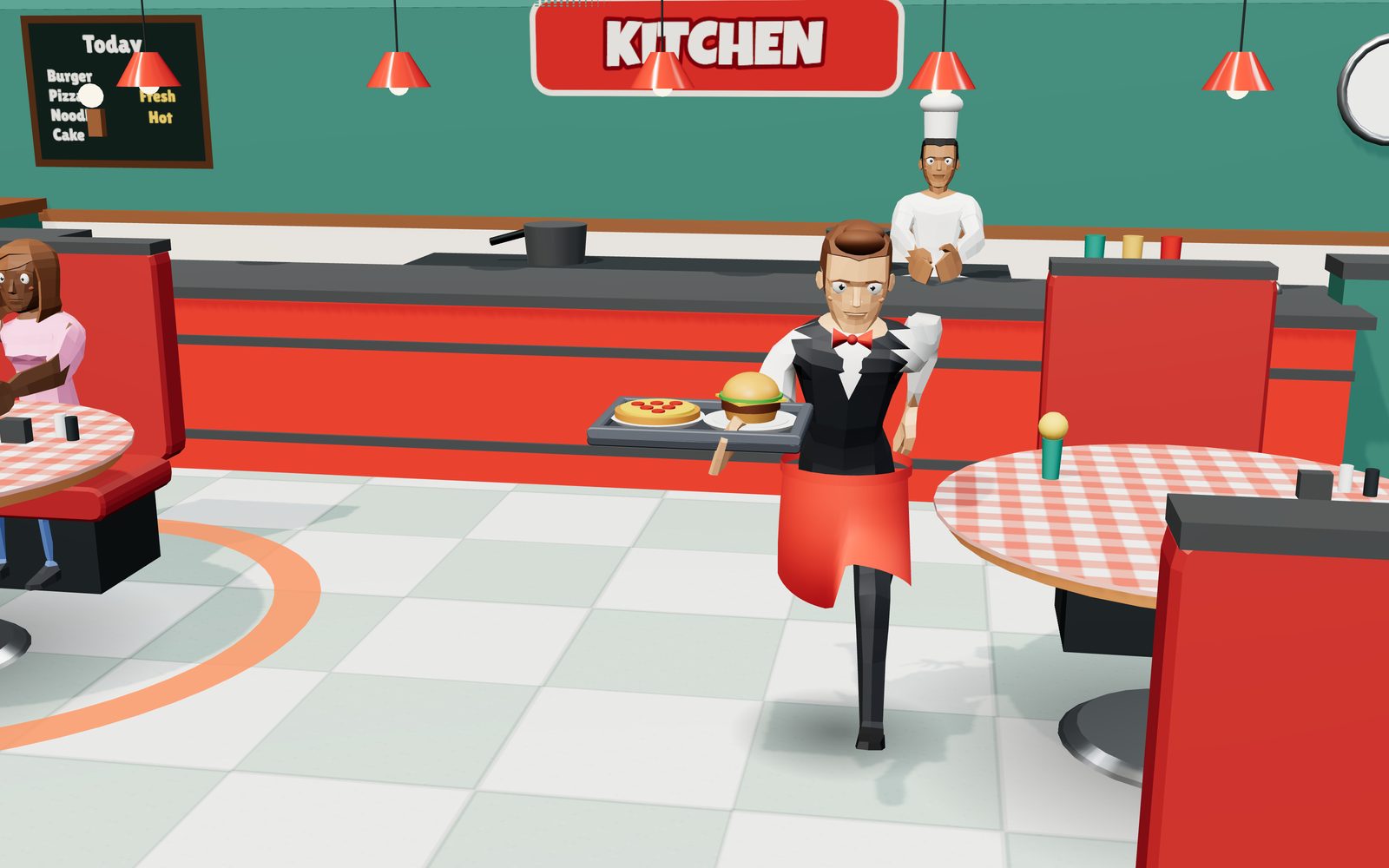
A dish takes 1.6 to 2.6 seconds to cook, and the customer's bar is already draining while it cooks. On level 1 that hardly matters. On level 8, cooking alone uses 8% to 13% of a 20-second bar. A VIP order there has 10 seconds, so the kitchen uses 16% to 26% of it before you can even pick the plate up. A tip of 10 needs more than 90% of the bar left, so on a late VIP order the best you can still earn is a tip of 9, and only if you are standing at the counter when the dish comes out.
The counter, or the galley on the plane, has five places for finished dishes, and you carry two. When two customers are waiting, I pick up both plates and plan the second drop on the way to the first.
The bin button drops the last dish you picked up. It costs no coins and your combo survives, but the kitchen cooks that dish again from the start while its customer's bar keeps draining. So the bin is a 1.6 to 2.6 second penalty, not a free undo. If I pick up the wrong plate, I bin it straight away rather than carry it around.
VIP guests
From level 2, some guests are VIPs, and a VIP guest's order is a VIP order 70% of the time. A VIP order pays double but comes with half the patience: 27 seconds on level 2, 18 on level 5 and 10 from level 8. Missing one costs exactly the same as missing a normal order. That makes a VIP the best bet in the game: twice the reward for the same risk, as long as you get there in time. When a VIP order and a normal order are both cooking, I serve the VIP first unless the normal one is about to run out.
Three stars
Stars are worked out when the level ends. Three stars needs no misses and, on average, at least half of the bar left when you served. Two stars allows one miss and needs at least 30% left on average. Any other finish is one star.
You can track this while you play by watching the tip that floats up after each serve. A tip of 6 or more means you served with more than half the bar left. If most of your tips are 6 or more and nobody walks out, you are on course for three stars.
The rush and the turbulence
Each level has one event, and it starts the moment you have served half of the level's orders: after your third serve on level 1, and after your sixth from level 5. In the diner, the dinner rush brings new orders twice as fast for 20 seconds. On the plane, turbulence slows you to 70% of your walking speed for 8 seconds. The limit on open orders still applies during a rush, so it fills the floor rather than flooding it.
Because your own serve starts the event, you can see it coming. Before I make that serve, I try to have both hands free and no order close to running out, so the rush starts on a clean floor.
Keep reading
The Tray Rush guide has the controls and the full table of orders, patience and penalties for every level. The two venues play differently, and The diner and the airplane explains how.
I write these guides with help from Claude, an AI assistant, and check every number against the game's code before a guide goes up.